
Love what you drive? Start your upgrade with handcrafted carbon fiber parts and accessories, precision-built for performance, style, and individuality.

You just invested in a sleek carbon fiber license plate frame or maybe a custom carbon fiber steering wheel for your prized Lamborghini. It’s not just an accessory—it’s a statement of identity. But then the question hits you: what happens if it gets too hot? Will carbon fiber melt?
No, carbon fiber doesn’t melt in the traditional sense. Instead, it undergoes sublimation at extremely high temperatures. Unlike plastic or metal, which softens or liquefies, carbon fiber transitions directly from a solid to a gas—without becoming liquid—at around 3,500°C (6,332°F), but only in a non-oxygen environment.
This unique property is part of what makes handcrafted carbon fiber so valuable in premium automotive builds. Let’s explore the science behind this heat resistance and why it matters when you’re choosing carbon fiber automotive parts for performance and aesthetic excellence.
Key Takeaways
- Carbon fiber does not melt; it sublimates at extreme temperatures.
- Its sublimation point is around 3,500°C, far beyond normal fire temperatures.
- What fails first is the resin matrix, not the carbon fiber itself.
- Custom carbon fiber accessories retain structural integrity until the resin burns away.
- Ideal for lightweight car performance upgrades due to heat and strength resilience.
- Best suited for high-end car accessories like dashboards, license plate frames, and more.
- Always choose made in USA carbon fiber to ensure premium quality and transparency.
Understanding Sublimation: Why Carbon Fiber Doesn’t Melt
The Science Behind It
Carbon fiber is made from strands of carbon atoms bonded together in a crystalline formation. These covalent bonds are exceptionally strong and stable. Unlike substances like wax or metal, which melt into liquid when exposed to heat, carbon skips the liquid phase entirely. Instead, it sublimates.
Sublimation is the process where a solid turns directly into a gas without becoming liquid.
| Material | Melting Point | Sublimation/Decomposition Point |
|---|---|---|
| Aluminum | 660°C | N/A |
| Steel | ~1,370°C | N/A |
| Resin (in carbon fiber composites) | ~250°C | Burns before melting |
| Carbon Fiber | N/A | ~3,500°C (inert environment) |
The Role of Resin in Carbon Fiber Car Parts
Resin: The Real Weak Point
Carbon fiber itself is extremely heat-resistant, but most carbon fiber automotive parts are actually composites made by embedding the fiber into a polymer resin. Epoxy resins are the most common.
Resins typically degrade or burn between 200°C and 300°C, meaning:
- The part may look damaged before the carbon fiber is compromised.
- Structural integrity may be lost if the resin matrix fails.
- Visible charring or softening often comes from resin, not the fibers.
This is why carbon fiber repair services focus heavily on resin refinishing, not just fiber replacement.
Real-World Implications for Exotic Car Carbon Fiber Parts
When you install premium carbon fiber components like:
- Custom carbon fiber steering wheels
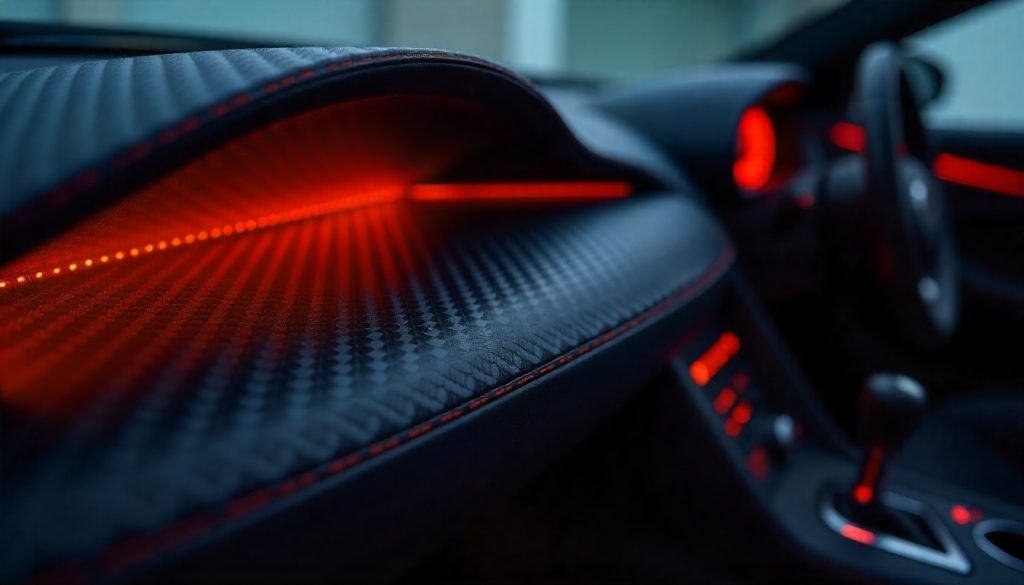
- Carbon fiber dashboard trim
- Carbon fiber key fobs and gifts
- UV resistant carbon fiber license plate frames
…you’re investing in form, function, and lasting resilience.
Everyday Scenarios
Here’s what happens in real-world situations:
- Summer sun in Arizona? No problem.
- Parked car cabin heat? Still safe.
- Near engine bay temperatures? Designed for it, if engineered properly.
But in cases of direct flame contact (house fire, car fire):
- Resin chars or burns
- Fiber stays intact longer, but the part may lose strength
Why This Matters in Performance Car Customization
Performance and Safety
Carbon fiber’s ability to withstand high temps without melting makes it ideal for:
- Aftermarket carbon fiber upgrades like hoods and spoilers
- Titanium wheel bolts and aluminum wheel spacers in close proximity
- Carbon/Kevlar custom finishes that need to hold up under track conditions
Style and Longevity
Your personalized carbon fiber accessories—from carbon fiber money clips to cigar holders—aren’t just good-looking. They’re made to endure.
Customer Story: Confidence in the Heat of Competition
“I installed Exotic Carbon Fiber’s custom dashboard trim and vent covers in my McLaren. Last summer, I was pushing it hard at a desert track day. The interior got insanely hot. The metal pieces were too hot to touch, but the carbon fiber? Still solid. Zero warping. That’s why I only go with made in USA carbon fiber now.”
Why Choose Exotic Carbon Fiber
As a brand, Exotic Carbon Fiber sets the bar for luxury automotive accessories that are as tough as they are elegant. Here’s what makes us different:
- Handcrafted carbon fiber, not mass-produced
- Transparent pricing with no hidden design fees
- Carbon fiber repair services and refinishing
- Designed, molded, and crafted in the USA
- Low minimum order quantity for custom projects
When you’re choosing carbon fiber car parts, trust the brand that understands that high-performance machines deserve high-performance materials.
FAQs About Carbon Fiber and Heat
Does carbon fiber burn?
Carbon itself doesn’t burn easily, but the resin around it can burn or char. Once resin burns off, the fiber might oxidize if oxygen is present.
Is carbon fiber fireproof?
It is extremely heat-resistant, but not 100% fireproof. In oxygen-rich environments, it can eventually oxidize.
Can I use carbon fiber near the engine?
Yes, many carbon fiber automotive parts are designed specifically for under-hood use. Always ensure it’s high-grade and heat-rated.
What if my carbon fiber gets scorched?
We offer carbon fiber repair services to restore damaged surfaces, depending on the extent.
Is the finish affected by heat?
UV resistant carbon fiber coatings help protect against both sunlight and moderate heat. Gloss and matte finishes remain stable under normal use.
External Resources
Related Products at Exotic Carbon Fiber
- Custom Carbon Fiber License Plate Frames
- Titanium Wheel Bolts for Performance Cars
- Carbon Fiber Key Fobs and Personalized Gifts
Final Thoughts
Carbon fiber is more than just a visual upgrade—it’s a material of choice for those who demand strength, heat resistance, and sophistication. When you choose custom carbon fiber accessories from Exotic Carbon Fiber, you’re not just enhancing your car—you’re making a statement about who you are.
And now, you can answer the question with confidence: Will carbon fiber melt? No. It was never built to.
Choose confidence. Choose craftsmanship. Choose Exotic Carbon Fiber.
By: Exotic Carbon Fiber Editorial Team
Disclaimer: This blog post is for informational purposes only and should not be considered professional advice.